
As consumers expect hygienic food and manufacturers in the food industry attach great importance to the quality of their products, it is imperative to avoid microbial contamination and the format I on of bio films. This makes targeted cleaning of the means of production indispensable. The nuts and bolts are the appropriate cleaning tool sand their proper application. First, it must be recognized where the germ cells for bacteria and pathogens are located in the production process in order to initiate effective control not only to ensure compliance with the legal limits, but also to minimize the number of undesirable microorganisms in terms of product quality.
The process of cleaning and disinfecting production equipment is demanding, but offers the opportunity to significantly influence the purity and quality of the food product. Hereby, the sensitivity of the processed foods to microbiological and chemical changes and, of course, the degree of soiling crystallizes as the main factors that mainly influence the frequency and intensity of the cleaning and disinfecting measures.
It is crucial in principle, the cleaning liquids reach all surfaces, so that germs and dirt are effectively eliminated. For this purpose, it makes sense to selectively vary the direction of flow of the cleaning media in the process, in order to free dead spaces or flow shadows of microorganisms. To protect consumers against health risks and to maintain quality standards, the highest care is required when handling food. Legal requirements must be met. Both national law and international guidelines specify a large number of binding rules of conduct in the processing process itself, but especially in the cleaning process. These must be internalized by the cleaning staff in order to always ensure a consistently high quality of cleaning. To realize an effective and efficient disinfection must first be thoroughly cleaned:
A sufficient amount of water ensures a removal of contaminants. Only then are plants, floors and walls foamed from bottom to top. A complete wetting of the entire surface including all gaps is indispensable for the cleaning success.
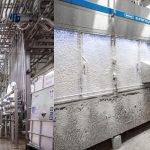
Foam is a substance that is formed by trapping gas/air inside liquids forming a sphere. The outer region is a thin film of liquid substance (water/detergent/chemical) that continues to expand to a point where it explodes. The bubble film carries the cleaning agent and holds it in place for a period of time to work on the contact surface.

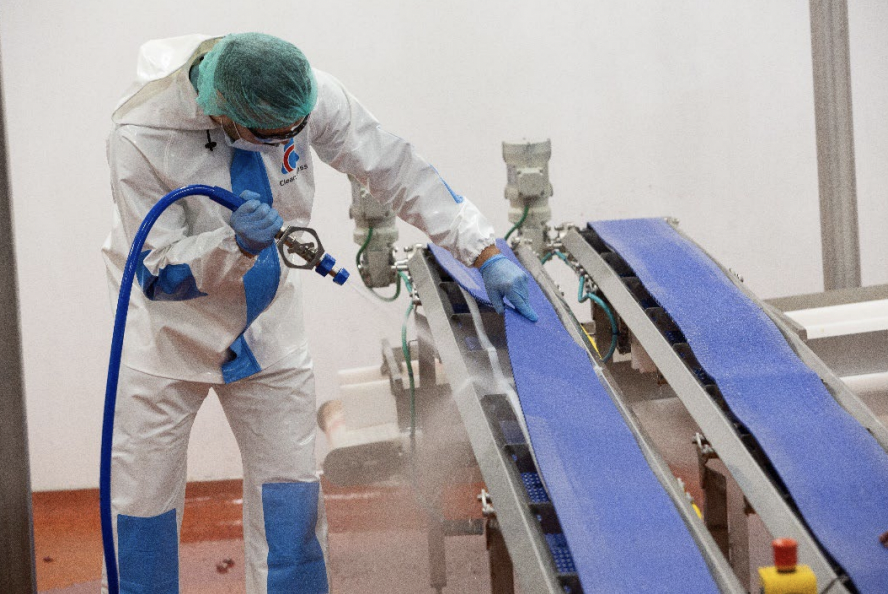
The foam composition that is, the mixing ratio of water, air and foam detergent, as well as the bubble size generated, determines the duration until the foam bubbles eventually burst and provide a continuous supply and cleaning medium. Depending on the application or type of soiling, a distinction is made between fine-loosely, firmly compact and flowing-dense foam structure. If the required exposure or contact time has elapsed, the surfaces are top-to-bottom-in reverse order-begun if necessary, manually, but usually with the high-pressure water jet depending on the system at a pressure of about 20-40 bar clean.
Once the cleaning and rinsing work has been successfully completed, the disinfection of all systems and surfaces is carried out in order to achieve the highest level of hygiene. Only if the number of germs and pathogens is at a level where they can no longer endanger products, the goal is achieved. For this purpose, a disinfectant solution is sprayed, foamed or fogged on all surfaces, which is also rinsed off completely and without residue after sufficient contact time with clear water.
A non-negligible aspect of disinfection is the surface or ambient temperature in the environment of the plants, walls and floors to be disinfected. Especially in the meat and fish processing is produced in a very low temperature environment, which prolongs the necessary exposure time of the disinfectant extremely or significantly worsens the actual disinfecting effect of the disinfectant. The low temperatures also counter act the drying process at the end of all cleaning efforts. Only when all surfaces have dried completely after cleaning, new bacterial growth is effectively counteracted.

Source: https://easyengineering.eu/ensuring-hygiene-in-production-facilities-in-the-food-industry/
Read more >>>CLEANING APPLICATIONS IN FOOD INDUSTRY